Registration for the 2026 Annual Convention is open!
Registration for the 2026 Annual Convention is open!
There is a lot of attention these days on the challenges of land access for agriculture. The Co-op Center is actively engaged in these conversations. See below for regional examples of land access projects we would like to highlight, and four distinct models popular around the country.
While organizational diversity makes it difficult to generalize or even categorize some land access projects, the variety of projects reminds us of the need to adapt to the local context and the continuing exploration of creative as well as collaborative models.
Partnering and networking with each other are important, as we explore ways to better serve beginning farmers and ranchers, offer access to individuals and groups who have difficulty obtaining land, and consider mixed uses of some properties where there can be elements of conservation, restoration, agricultural production, affordable housing, and land sharing for gathering plants for cultural uses.
Rio Grande Farm Park, Alamosa, Colorado
Poudre Valley Community Farms, Laporte, Colorado
Montezuma Land Conservancy, Cortez, Colorado
The Old Fort at Hesperus, Colorado

Agriculture Commons Model
Relatively new “commons” projects have been developed by the Agrarian Trust and by the Farmers Land Trust along with other organizations. There are now numerous commons initiatives scattered across different regions of the US. The Agrarian Trust offers administrative and other forms of support for the Agrarian Commons. The Farmers Land Trust operates both as a resource hub and a coordinator of commons. Commons typically involve perpetual leases of tracts of land for agriculture, conservation and sometimes housing. Individual commons may be incorporated in a variety of ways. These initiatives revive the ancient idea of a commons but place it in a network of support structures and sharing of resources with other commons initiatives. The model is designed, ultimately, to give autonomy to the commons membership while freeing them from financial responsibility of land ownership and all that entails. Members maintain their own businesses; some may live on the farm.

The diagram titled “Worker-Owned-and-Governed Cooperative Farm” outlines the organizational structure and relationships within a cooperative farm model.
Another model that is still not widely known but familiar to the greater RMFU community is a worker-owned cooperative farm. In these initiatives, which are also found around the country, ownership is held in common by all members. The cooperative is also governed by members, even if it is incorporated in another form (often an LLC). Individuals or households invest in the enterprise, receive what are called “patronage dividends” along with agreed-upon wages, and have direct influence in shaping the direction of the enterprise. (See this article on the structures and practices of worker cooperatives: See article on Worker Cooperatives. This model, too, may include housing, at least for some members. An example that has garnered a great deal of media attention is the Love is Love Cooperative Farm in Mansfield, Georgia.
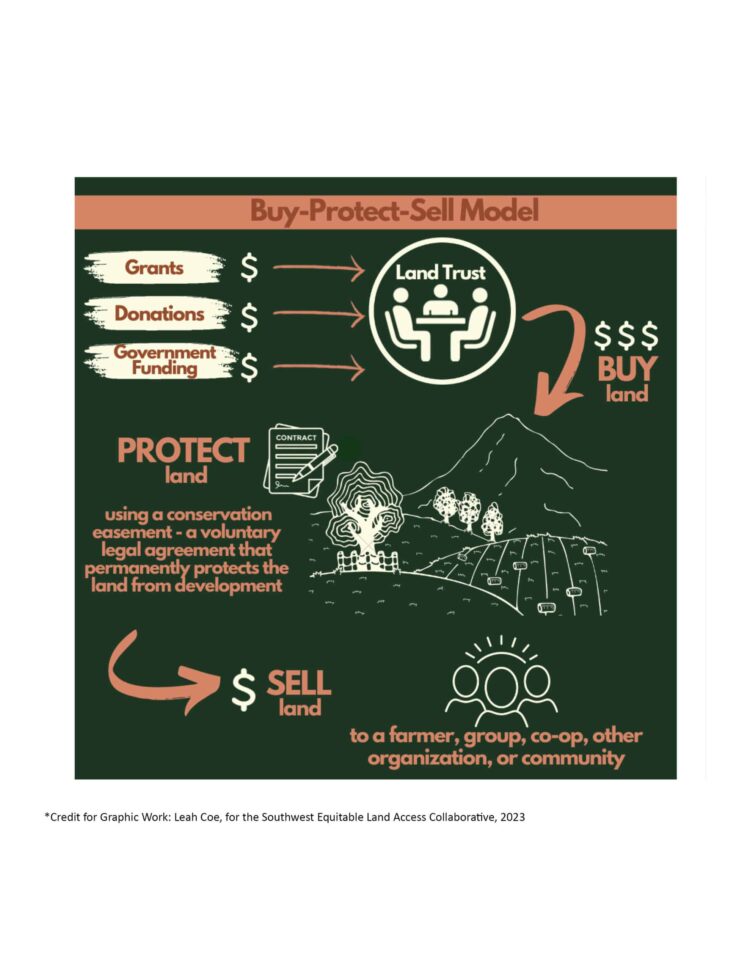 Buy-Protect-Sell Model
What is called the “buy-protect-sell” model is commonly found under the auspices of a land trust, which could have an urban, rural, or wider field of work. These initiatives usually involve long-term leases; they also can lead to purchases of land by individuals, groups, or communities. In this way, there can be steps towards the relative autonomy of a group or newly formed organization. Multiple goals can be pursued with these initiatives as well: including farming/gardening spaces for a variety of ethnic groups, CSAs, therapy and medicinal gardens, and areas devoted for children. Groundswell Conservancy, in Madison, Wisconsin, embodies this multi-dimensional approach, and they are contemplating the incubation of worker cooperatives.

Indigenous experience, rights, and capacities to influence the future of land access are most clearly found in the Land Back movement. An outstanding example is the Dishgamu-Humboldt Community Land Trust in Eureka, California is grounded in reclamation, restoration, and a holistic approach to people and land. Dishgamu means love in the Wiyot language. With the first non-mandated return of land to tribal sovereignty in the US, the Wiyot Tribe has assumed stewardship of overused and degraded areas in and around Eureka, forged partnerships with other organizations, revived sacred ceremonies, and is now educating people in the wider region not only about tribal culture and traditions but also about sustainable land use practices.
For more information, contact George Cheney